
Yes. This is one of those simple recommendations that has good science behind it.
Children who spend more time outdoors are less likely to develop myopia, or nearsightedness. Randomized clinical trials and systematic reviews support increasing outdoor time as a practical way to reduce a child’s risk of becoming myopic. [jamanetwork.com] 403, [pmc.ncbi.nlm.nih.gov]
To understand why this matters, it helps to understand what myopia really is.
Myopia Is About Eye Growth
In most childhood myopia, the eye grows too long from front to back. This is called axial elongation.
As the eye becomes longer, light focuses in front of the retina instead of directly on it, making things in the distance look blurry. Glasses or contact lenses correct the blur, but they do not change the length of the eye. In fact, as the eye grows longer and becomes more myopic, a stronger prescription is typically needed to bring things back into focus.
Beyond the need for stronger glasses, why does eye length matter? Because as the eye becomes more elongated, the retina is mechanically stretched and weakened. Over time, a longer, more myopic eye has a greater risk of problems involving the retina. Specifically, we are talking about retinal detachment, as well as changes in the macula, the central part of the retina responsible for our sharpest vision.
This does not mean that every child with myopia will develop such problems. The risk generally increases as myopia and axial length increase.
That is why our goal is not simply to keep a child's glasses prescription lower. We want to limit excessive eye growth and help keep the eye from becoming more elongated than it needs to be, protecting the retina and the long-term health of the eye.
Why Does Being Outdoors Help?
We do not yet know the complete biological explanation, but the protective effect of outdoor time is well supported.
In a landmark randomized clinical trial published in JAMA, first-grade children at certain schools received an additional 40 minutes of outdoor activity each school day. After three years, myopia had developed in 30.4% of children in the outdoor group, compared with 39.5% in the control group. [pubmed.ncb...lm.nih.gov], [researchgate.net] 403
A later school-based randomized trial using objective measurements of outdoor exposure and light also found that increased outdoor time reduced the development of myopia. [aaojournal.org]
Children do not necessarily need to be exercising vigorously. The evidence suggests that being outdoors and receiving outdoor light exposure are more important than the particular activity.
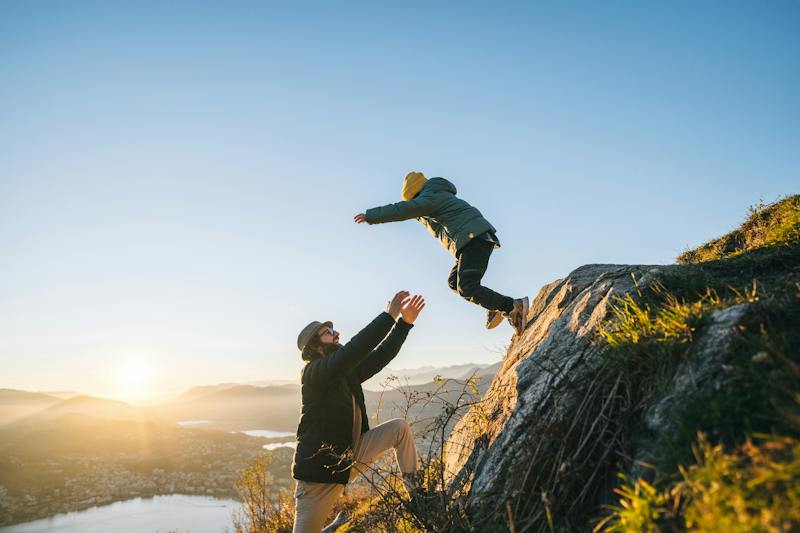
Playing a sport is great, but so are walking the dog, riding a bike, visiting a playground, eating lunch outside or simply spending time outdoors.
How Much Outdoor Time Is Enough?
There is no scientifically established magic number.
Studies have used different amounts of outdoor exposure, but the overall pattern is consistent: children who spend more time outdoors generally have a lower risk of developing myopia. [pubmed.ncb...lm.nih.gov], [pmc.ncbi.nlm.nih.gov]
The practical advice is simple:
Make outdoor time a regular part of your child’s day whenever reasonably possible.
It does not need to be complicated or structured specifically as an eye exercise.
What About Reading, Homework and Screens?
Near work includes reading, writing, homework and using phones, tablets or computers. Research has found an association between greater near-work exposure and childhood myopia, although that does not prove that any single activity directly causes it. [journals.plos.org], [spandidos-...ations.com]
I do not tell children to stop reading, and I do not want parents turning books or homework into the enemy!
A more practical approach is to:
- Avoid holding books or screens unnecessarily close
- Interrupt long periods of continuous near work
- Balance indoor activities with regular time outdoors
You may have heard of the 20-20-20 rule: every 20 minutes, look approximately 20 feet away for 20 seconds.
This is an easy reminder to take a break during prolonged near work, but this specific “rule” has not been proven to prevent myopia or slow axial elongation. Research also has not established that 20 minutes, 20 feet and 20 seconds are uniquely effective numbers. [pubmed.ncb...lm.nih.gov]
I think of it as a practical break-taking habit, not as a myopia treatment.
What If My Child Is Already Nearsighted?
This is an important distinction.
Outdoor time has its strongest evidence for reducing the likelihood that myopia develops in the first place.
Once a child already has progressive myopia, evidence that outdoor time alone substantially slows further progression is inconsistent. A 2024 meta-analysis found that greater outdoor time reduced the onset of myopia but did not significantly slow progression among children who were already myopic. [pubmed.ncb...lm.nih.gov]
Outdoor activity remains a healthy habit, but should not be considered a replacement for physician-led myopia management when a child’s eyes continue to elongate.
Why We Measure Axial Length
Axial length is the measurement of the eye from front to back.
A child’s prescription tells us how the eye is focusing. Axial length helps us understand how the eye itself is growing.
These measurements are related, but they are not interchangeable. When appropriate, following both can provide a more complete picture of how a child’s myopia is behaving.
The Bottom Line
Yes, outdoor playtime can help protect children’s vision.
The best evidence shows that spending more time outdoors can reduce a child’s likelihood of developing myopia. Brief breaks during prolonged near work are also sensible, but the 20-20-20 rule has not been proven to prevent myopia or control eye growth.
For children who are already myopic, healthy visual habits remain worthwhile, but they do not replace appropriate myopia management.
Ultimately, our goal is not simply to keep a glasses prescription lower. It is to encourage healthy eye growth and, when myopia develops, to limit excessive axial elongation as much as reasonably possible.
That is what matters most for a child’s long-term eye health.