
Parents often use terms like “lazy eye,” “crossed eyes,” or “wandering eye” to describe a child’s eyes. The problem is that these everyday terms don’t tell us exactly what is happening.
As a pediatric ophthalmologist, I find it much more helpful to separate two different questions:
- Are the eyes lined up with each other?
- Is the brain learning to use the vision from each eye properly?
Those are not the same thing.
“Crossed eyes” usually means strabismus
Strabismus is the medical term for eyes that are not properly aligned with each other.
But not all strabismus looks like crossed eyes.
An eye can turn:
- Inward, toward the nose. This is called esotropia.
- Outward, away from the nose. This is called exotropia.
- Upward or downward relative to the other eye. This is called vertical strabismus, such as hypertropia or hypotropia.
The misalignment can be present all the time or only occasionally. Sometimes the same eye turns each time; in other children, the eye that turns may alternate.
So when a parent tells me that a child has a “crossed eye” or a “wandering eye,” the first thing I want to determine is what kind of eye misalignment is actually present.
What about a “lazy eye”?
This term causes even more confusion.
People often use “lazy eye” to mean an eye that turns. But medically, lazy eye usually refers to amblyopia.
Amblyopia develops during childhood when the brain does not learn to use the vision from one eye normally.
This can happen for several reasons. One eye may be much more nearsighted or farsighted than the other. One eye may be misaligned. Less commonly, something may interfere with a clear image reaching the eye during early visual development.
When the brain consistently receives a better image from one eye than the other, it may learn to rely more heavily on the better-seeing eye. As a result, normal vision does not develop in the other eye.
That distinction is important:
Strabismus is primarily a problem of eye alignment. Amblyopia is a problem of visual development in the brain.
The two can occur together, but they don’t have to.
A child can have:
- Strabismus without amblyopia
- Amblyopia without strabismus
- Both strabismus and amblyopia
For example, a child can develop amblyopia because one eye has a much stronger glasses prescription than the other, even though the eyes look perfectly straight.
Why the distinction matters
Calling everything a “lazy eye” can make it sound as though these conditions are all the same. They aren’t.
With strabismus, we need to determine why the eyes aren’t properly aligned and what type of misalignment is present.
With amblyopia, we need to determine why the developing brain has not learned to use the vision from one eye normally.
When both are present, each problem may need to be addressed.
Treatment therefore depends on the actual diagnosis. Depending on the child, treatment may include glasses, treatment for amblyopia such as patching or atropine, treatment of the strabismus itself, or sometimes eye-muscle surgery.
Frequently Asked Questions
Is a lazy eye the same thing as a crossed eye?
No. “Lazy eye” usually refers to amblyopia, which occurs when the developing brain does not learn to use the vision from one eye normally.
Crossed eyes are a form of strabismus, meaning the eyes are not properly aligned.
A child can have either condition alone or both together.
Can a child have amblyopia even if both eyes look straight?
Yes. In fact, amblyopia can be difficult for parents to recognize because the eyes may look completely normal.
For example, if one eye is much more nearsighted or farsighted than the other, the brain may learn to rely on the eye providing the clearer image. The child may not complain because the better-seeing eye is doing most of the work.
Does an eye that turns always become amblyopic?
No. Some children with strabismus develop amblyopia, while others do not.
This is one reason an eye examination is important. Looking at the position of the eyes alone cannot tell us how well each eye sees.
Can amblyopia be treated?
Yes. Treatment is designed to help the developing brain learn to use the weaker eye more effectively.
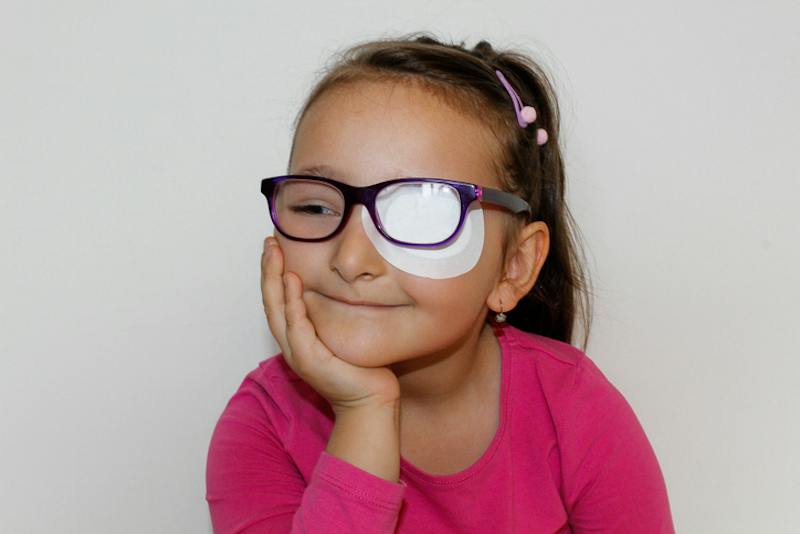
Depending on the cause, treatment may include glasses and, when needed, patching of the stronger eye or atropine drops. The best treatment depends on the individual child.
Does patching straighten a crossed eye?
Not necessarily. Patching treats amblyopia, not the eye misalignment itself.
If a child has both amblyopia and strabismus, we may need to address both problems. Depending on the type of strabismus, treatment of the alignment may involve glasses, other treatments, or eye-muscle surgery.
When should a child with a suspected lazy or crossed eye be examined?
If you notice that your child’s eye is turning in, drifting out, or sitting higher or lower than the other eye, it is worth having it evaluated.
The same is true after an abnormal vision screening or whenever there is concern that one eye may not see as well as the other.
Young children often don’t realize that one eye sees differently because that is the way their visual world has always looked to them.
The bottom line
“Lazy eye” and “crossed eyes” are understandable everyday terms, but they aren’t very precise.
Instead, I prefer to ask:
Is there a problem with how the eyes are aligned, how the brain is using the vision from each eye, or both?
If the eyes are misaligned, we call that strabismus, and we describe the direction of the misalignment: inward (esotropia), outward (exotropia), or vertical.
If the brain has not learned to use the vision from one eye normally during childhood, we call that amblyopia.
Getting the terminology right isn’t just semantics. It helps us understand what is actually happening with a child’s vision and, most importantly, what needs to be treated.