

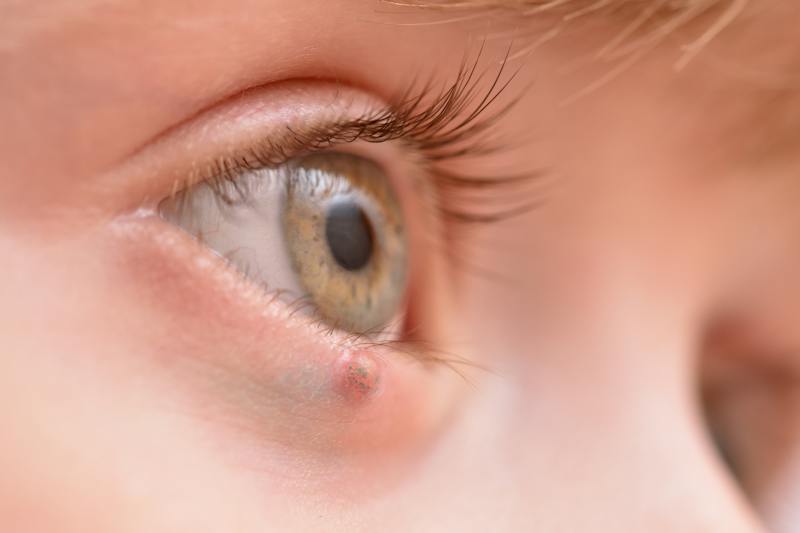
One of the more common reasons parents bring a child to my office is because of a bump on the eyelid that "just won't go away."
The good news? The vast majority of the time, it's nothing dangerous. In fact, it's the eyelid version of a pimple.
Like a pimple, a chalazion develops when an oil gland gets clogged. The difference is that it happens inside the eyelid.
Oil is an essential part of our tear film, so we need the oil glands in the lids to function properly. When oil gets trapped under the skin instead of being secreted into the tear film, the body's immune system treats it as foreign material, much like a splinter. The result is inflammation and formation of the familiar eyelid lump.
Chalazion vs. Stye: What's the Difference?
Parents often use the term "stye" for any eyelid bump, but there are actually different types of eyelid pimples.
A chalazion occurs when one of the eyelid's oil-producing glands, called a meibomian gland, becomes blocked. Oil gets trapped inside the gland, producing inflammation surrounded by a membrane. The end result is a lump within the eyelid.
A hordeolum (the medical term for a stye) occurs when the oil gland associated with an eyelash follicle becomes clogged. These sometimes get infected, too.
A chalazion is found away from the lid margin, while a hordeolum is usually near the edge of the eyelid.
In practical terms, the distinction doesn't matter very much.
Both are common in children.
Both are bumps on the eyelid.
Both result from blocked glands.
And most importantly, the treatment is usually the same.
Why Do Some Children Keep Getting Them?
Some children seem to get chalazia over and over again.
Often, the underlying issue is that the oil glands in the eyelids are not functioning particularly well. The oils become thick, the glands clog more easily, and chalazia (the plural of chalazion) develop repeatedly.
This is the same idea as having oily skin and being prone to acne. Some children are simply more susceptible than others.
How Are Chalazia Treated?
Fortunately, most chalazia can be treated conservatively.
Hot Compresses
The first step is usually hot compresses.
Heat softens the thickened oil trapped inside the gland and encourages it to drain naturally.
I recommend placing a hot/cold pack in the microwave for 10-15 seconds, testing it on your own skin first to make sure it won't cause a burn, and then applying it to the eyelid for 5 minutes two or three times a day.
Another option: use a potato or egg. They hold heat remarkably well.
The challenge, of course, is convincing a toddler to sit still for this. Cuddling on the couch to watch some TV goes a long way.
Eyelid Hygiene
For children who develop recurrent chalazia, eyelid hygiene can be useful.
Keeping the eyelid margins clean helps reduce future blockages and improve the health of the meibomian glands.
Bargain-basement option: add a teaspoon of baby shampoo to a cup of warm water and use a clean towel (not a paper towel!) to gently scrub the eyelid margin at the lashes.
Another good option is one of the commercially available lid scrub products available online or at your local pharmacy.
Omega-3 Supplementation
For children prone to recurrent chalazia, I often recommend omega-3 supplementation as part of a prevention strategy.
One product I frequently recommend is Barlean's Flax Seed Oil, which is generally accepted by children. They can take it off a spoon or use it as a topping on ice cream.
Omega-3 fatty acids may help improve the quality of the oils produced by the meibomian glands, making future blockages less likely.
It's not a miracle, it won't do anything for the chalazion that's already there, and it isn't an overnight fix. However, it may help reduce the frequency and severity of future chalazia in children who seem particularly prone to them.
Do Antibiotics Help?
Rarely.
Parents are often surprised to hear this, but chalazia are not active infections. Remember: it's sterile oil that has been trapped and walled off.
Because a chalazion is a blocked oil gland, antibiotic drops and ointments don't do anything.
It is rare for a chalazion to become infected, but styes (hordeola) become infected more often. In the event of infection, antibiotics definitely play a role.
What About Steroid Injection Into the Chalazion?
This is often a good option between hot compresses and surgery.
The medication is injected directly into the chalazion and can help shrink the inflammatory tissue over several weeks. Not every chalazion responds completely, but most improve substantially and this can help to avoid surgery altogether.
In my practice, I usually start discussing steroid injection when a chalazion has failed to improve after 2-3 weeks of good attempts at hot compresses.
Of course, the child has to be emotionally mature enough to allow an injection into the eyelid. Most kids around age 9 and older can usually handle this quite well.
When Does a Chalazion Need Surgery?
Most chalazia improve with time and hot compresses.
Sometimes, however, a chalazion is stubborn.
If it has been present for months, is large, causes cosmetic concerns, affects vision, or simply refuses to go away despite treatment, surgical drainage is an option.
The procedure is straightforward. A small opening is created in the eyelid, and the trapped oil and inflammatory material removed.
Whenever possible, the incision is made on the undersurface of the eyelid. When a chalazion is draining through the skin surface, surgery can restore a more normal appearance, but there will be a scar (usually a faint one).
For younger children, surgery is performed in an operating room with general anesthesia.
In-Office Chalazion Drainage
Chalazion surgery for younger children must be performed in an operating room with general anesthesia.
Older, more emotionally mature children (typically age 9+) can often understand and tolerate surgical drainage in the office. The eyelid is numbed first, and then the procedure is performed.
Beginning in late 2026, our practice plans to offer in-office chalazion drainage for children who are mature enough to comfortably tolerate the procedure while awake.
Not every child is a good candidate for in-office surgery, but for the right patient, avoiding a trip to the operating room can be a tremendous convenience. No fasting, no IV, no general anesthesia, no missed school, and no parent taking a day off from work. For mature children who can comfortably cooperate, it can be an excellent alternative to surgery in the operating room.
We'll discuss the available approaches and determine which setting is safest and most appropriate for your child.
When Should My Child See a Pediatric Ophthalmologist?
Consider an evaluation if:
- The bump persists for more than a few weeks
- The eyelid is becoming increasingly swollen
- Chalazia are recurring frequently
- The lesion is affecting vision
- You are unsure whether it is truly a chalazion
Most eyelid bumps in children are exactly what they appear to be: a pimple. Still, when they become recurrent, persistent, or unusually large, it's worth making sure there isn't a better treatment plan available.
Frequently Asked Questions
Can a chalazion go away on its own?
Yes. Most chalazia gradually resolve over several weeks with time, hot compresses, and patience.
Are chalazia contagious?
No. Chalazia are not contagious and cannot be spread from one child to another.
Can my child go to school with a chalazion?
Yes. Children can continue their normal school and extracurricular activities.
How long does a chalazion last?
Some resolve within a few weeks. Others can persist for months if the trapped oil and inflammatory material do not drain on their own.
The Bottom Line
A chalazion is essentially a blocked oil gland in the eyelid: a pimple. A stye is slightly different, involving a different oil gland associated with the eyelashes, but the two conditions are closely related and usually treated the same way.
Most children improve with hot compresses and patience. Omega-3 supplementation, such as Barlean's Flax Seed Oil, may help reduce the likelihood of future chalazia in children who seem particularly prone to them. For stubborn bumps that won't resolve, steroid injection and surgical drainage remain excellent elective treatment options.
And sometimes, the hardest part of treatment isn't the medicine. It's convincing a three-year-old that a hot compress on the eye for five minutes is actually a good idea.
Dr. Eric Lichtenstein is a board-certified pediatric ophthalmologist and strabismus surgeon who cares for infants, children, and adults with complex eye muscle disorders throughout Queens and the New York metropolitan area.