

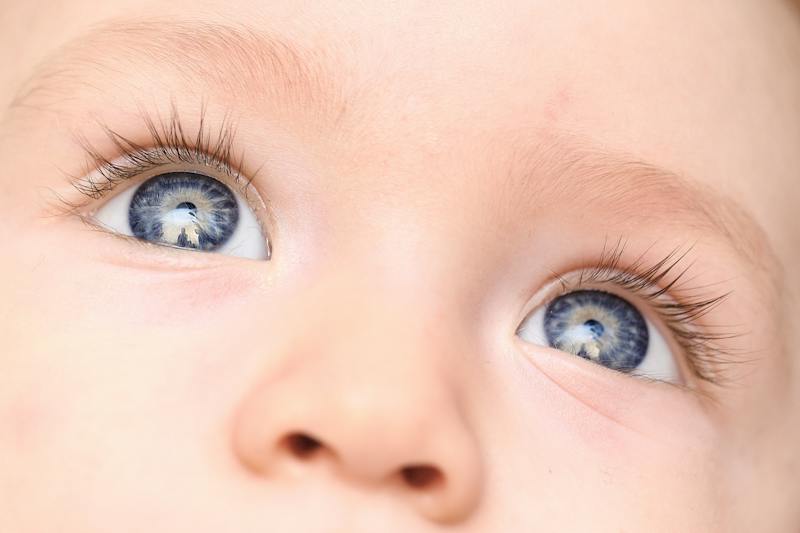
A frequently or constantly watery or crusty eye is quite common in newborns and babies. Parents often wonder whether it means their baby has an eye infection.
When the eye is white and “quiet” looking, the problem often isn't the eye itself. It's the drainage system for the tears.
The medical term is nasolacrimal duct obstruction (NLDO), more commonly called a blocked tear duct.
Where are tears supposed to go?
Tears don't normally just evaporate or spill down our cheeks. They drain through tiny openings near the inner corners of the eyelids, travel through a small drainage system, and eventually empty into the nose. Every time we blink, a small amount of our tears gets pushed into this drainage system.
That's why our nose runs when we cry.
In some babies, this drainage pathway isn't completely open at birth. Most commonly, a thin membrane remains across the lower end of the tear duct and prevents tears from flowing freely into the nose. Sometimes, the bone around the tear duct is too tight.
Think of it as a tiny drain that hasn't completely opened yet.
Why does the eye keep watering?
The eye continues making tears normally. But if those tears can't drain properly, they back up.
The result is an eye that may look constantly wet, with tears spilling onto the cheek even when your baby isn't crying.
The important idea is simple:
The eye isn't necessarily making too many tears. The tears just aren't draining normally.
And what's all that “goo”?
This is often what worries parents most.
The lining of the tear drainage system produces mucus, just like the lining of the nose. When the tear duct is blocked, that mucus can't drain normally either. It can back up and appear as yellow-white discharge or crusting on the eyelashes.
You may clean your baby's eye and find it “gooey” again a few hours later.
Blocked tear duct or pink eye?
One helpful clue is what the eye itself looks like.
With a blocked tear duct, there may be plenty of watering and discharge, but the white part of the eye usually isn't red. The American Academy of Ophthalmology notes that typical NLDO often occurs without abnormalities of the conjunctiva or cornea.
A very red eye, significant swelling, obvious discomfort, sensitivity to light, or an eye that looks cloudy or otherwise unusual deserves medical attention rather than simply being assumed to be a blocked tear duct.
Will a blocked tear duct go away on its own?
Usually, yes.
About 5% of newborns have NLDO. Another way to picture that: for every 1,000 babies born, about 50 will have a blocked tear duct.
By around the first birthday, roughly 90% or more of those blocked tear ducts will have resolved without a procedure. So, of those 50 babies out of 1,000, only a small number will still have an obstruction around their first birthday.
As the baby's face grows, the tear duct enlarges, the membrane obstruction may open, and the bone around the duct enlarges. That's why we often wait awhile for a blocked tear duct to resolve on its own.
Spontaneous resolution can still occur after the first birthday, but it becomes less likely as a child gets older. Studies differ on exactly when that decline becomes most important, which is one reason the timing of treatment is individualized.
What can parents do in the meantime?
I often recommend gentle massage of the tear sac, located at the inner corner of the eyelids next to the nose.
Under the little bump next to the nose is the tear sac. The rest of the tear duct is covered by bone, so there's no point massaging down the side of the nose itself.
Massage helps clear accumulated mucus and debris and may also help the obstruction open while we're waiting for the tear duct to grow and open up.
Does my baby need antibiotic drops?
Nope. Not for the blocked tear duct.
A blocked tear duct by itself doesn't require antibiotics. The issue is that sometimes bacteria overgrow within the stagnant material inside the blocked drainage system; antibiotic drops may then be appropriate.
But there's an important distinction:
Antibiotic drops can reduce bacterial overgrowth. They don't open a blocked tear duct.
What if it doesn't go away?
Most blocked tear ducts improve on their own. But if the blockage persists, there is a decision to make.
Waiting is perfectly reasonable because the tear duct may still open on its own. But there is also a window when I can often open the tear duct with a simple probing in the office, rather than taking the chance that a procedure under general anesthesia will be needed later.
I generally consider office probing at around 6 to 10 months of age, depending on the baby and the circumstances.
During the procedure, I pass a sterile, thin, smooth probe through the natural tear-duct opening in the eyelid and down through the tear duct. If a thin membrane is causing the blockage, the probe opens it.
The advantage of doing this while the baby is younger is that the procedure can often be done quickly and safely in the office, without general anesthesia. If the baby is moving too much for me to proceed safely, I stop.
Waiting is still a reasonable choice. There isn't one right answer for every baby, so I discuss the advantages of continued observation versus office probing with each family.
Frequently Asked Questions
Is a blocked tear duct painful?
Usually not. Babies with typical NLDO can act perfectly normally despite having quite a bit of tearing or discharge.
What can be uncomfortable is the dry skin that develops around the eye. When the tears evaporate, they leave behind salt and protein, which can cause the skin to dry out and perhaps even crack. Plain Vaseline twice a day goes a long way. Sometimes, antibiotic ointment is indicated to control these minor skin infections.
Can just one eye be affected?
Yes. A blocked tear duct can affect one eye or both eyes.
Why does the discharge keep coming back after I clean it?
Because cleaning the eyelashes removes the discharge but doesn't change the underlying drainage problem. Until the duct opens, tears and mucus can continue to accumulate.
Does yellow discharge mean my baby has an infection?
Not necessarily. A blocked tear duct itself can cause crusting and discharge because tears and mucus aren't draining normally.
Will massage cure the blocked tear duct?
No. Massage can help clear accumulated mucus and debris and keep symptoms under control while you're waiting for the obstruction to improve.
Do antibiotic drops open a blocked tear duct?
No. Antibiotics may be helpful when bacterial overgrowth is present, but they don't fix the underlying blockage.
Why would I consider probing if the tear duct may still open on its own?
It's a trade-off.
At 6 to 10 months, there is still a meaningful chance that the obstruction will resolve naturally. So there is usually no requirement to intervene simply because the tear duct is still blocked.
On the other hand, this may be an opportunity to correct the obstruction with a brief office procedure and potentially avoid general anesthesia later. I discuss the advantages and disadvantages of waiting versus office probing with each family.
When should I be concerned?
Significant redness, swelling, apparent pain, sensitivity to light, or an eye that looks cloudy or otherwise unusual should be evaluated. Those findings aren't typical of a simple blocked tear duct and can indicate another eye problem.
The Bottom Line
If your baby's eye is constantly watering or repeatedly getting crusty, a blocked tear duct is one common explanation.
The easiest way to think about it is:
The eye is making tears normally. The tears and mucus just aren't draining normally into the nose.
Fortunately, most blocked tear ducts improve naturally as babies grow. In the meantime, gentle massage can help control the buildup of discharge, and antibiotic drops are used only when they are actually needed.
If the blockage persists, there may also be a window during later infancy when I can open the tear duct in the office, potentially avoiding a procedure under general anesthesia later.
If the symptoms persist, or something about the eye doesn't look typical for a simple blocked tear duct, I can determine whether we're still dealing with a routine blocked tear duct and whether continued observation or treatment makes sense.