
View Other Patients



Exotropia and Hypotropia
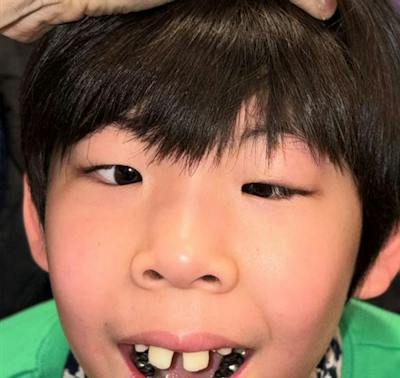
Lou had a more complex form of strabismus involving both an outward eye turn (exotropia) and a vertical misalignment, with one eye sitting higher than the other. These combinations are often more noticeable than a simple horizontal eye turn because the eyes appear out of balance in more than one direction.
The photograph on the left is Lou's school portrait. Like many children with strabismus, he had adapted remarkably well. Children are often far less bothered by their eye alignment than the adults around them. Nevertheless, a significant misalignment can affect appearance, binocular vision, depth perception, the way the eyes work together, and self-esteem.
After a careful evaluation and discussion of the available options, Lou's family chose eye muscle surgery.
The Procedure
Strabismus surgery is not technically difficult for a trained ophthalmologist. Doing it well, however, requires understanding exactly what is wrong and selecting the proper procedure. In Lou's case, both the horizontal and vertical components of the misalignment had to be considered when planning surgery.
The goal is not merely to correct a number on an eye chart or straighten an eye in a photograph. The goal is to improve the relationship between the eyes so that they appear and function better together.
As with all strabismus surgery, the procedure was performed on the muscles attached to the outside of the eye. The eye itself is never removed, and strabismus surgery does not involve operating inside the eye. This is one reason strabismus surgery is generally considered very low risk for vision loss.
Lou's surgery was performed as an outpatient procedure, allowing him to return home the same day.
The Result
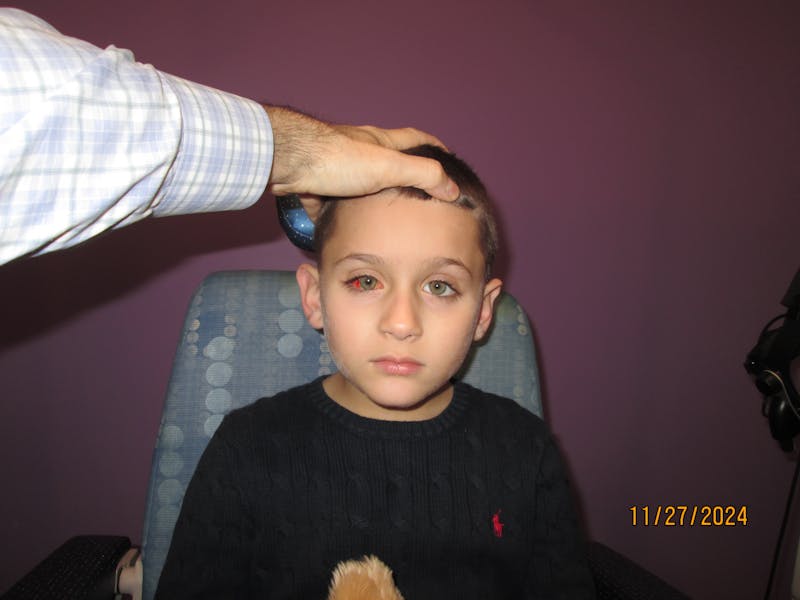
The photograph on the right was taken just one week after surgery.
Even at this early stage, there is already a substantial improvement in both the horizontal and vertical alignment of Lou's eyes. Redness is expected but temporary and typically resolves over the following four to eight weeks.
One of the most rewarding aspects of pediatric strabismus surgery is seeing a child who suddenly appears more comfortable, balanced, and naturally aligned. While perfect symmetry is not always achievable, meaningful improvement is often possible even in more complex cases.
The Lesson
Not all strabismus is the same.
Some have a simple inward or outward eye turn. Others, like Lou, have a combination of horizontal and vertical misalignment that requires a more individualized surgical plan.
The first question is never, "How do we do the surgery?" The first question is, "What problem are we trying to solve?" Once that is understood, careful examination and thoughtful surgical planning can usually produce meaningful improvements in alignment, appearance, and binocular function.
Every child is different, and the decision to proceed with surgery is always based on the individual’s pattern of eye alignment, visual function, and their goals.